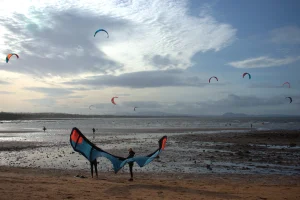

Beyond the wind: dunes, oysters, lagoon sunsets and that famous Saharan emptiness. What Dakhla really is — and what it isn’t.
Dakhla sits at the edge of the Western Sahara, on a narrow peninsula squeezed between the Atlantic and a giant lagoon. Geographically and mentally, this is the end of the road. Literally. The region is sparsely populated, the distances are long, and the landscape is extreme in its sameness.
Dakhla is not a classic destination. There is no city with landmarks, no museums, no cathedral, no medina, and no string of “one-new-thing-a-day” excursions. Put plainly: this isn’t a place where you build a daily sightseeing program. If you arrive expecting Morocco in the style of Marrakech, Fes or Essaouira, disappointment is almost guaranteed. Dakhla is not a cultural capital, it isn’t an architectural postcard, and it isn’t a destination for classic sightseeing. Realistically, one of the main “activities” in Dakhla is doing absolutely nothing. That’s not a marketing line — it’s a fact. And it isn’t a weakness, it’s the whole concept.
What to do when there’s no wind
If the wind blows, the answer is obvious: get on the water. If it doesn’t, time stretches out. Here’s what’s actually on the menu.
1. The town of Dakhla itself
The town itself offers very little: a short walk through the centre, a local market, a handful of shops, basic cafés and tea houses, and infrastructure that mostly serves the locals. That’s it. The odds that Dakhla as a “town” will wow the average tourist are low.
But Dakhla isn’t trying to entertain you. It’s trying not to disturb you. Once you’ve seen the town — which doesn’t take long — what’s left are a few simple experiences that fill a windless day. They work precisely because they fit the surroundings, not because they’re must-see attractions.
2. Oyster farms
Thanks to the mixing of Atlantic water, constant currents and the shallows, the lagoon at Dakhla is a rich marine zone. Long before the farms appeared, fishing was a basic activity for the locals. The Atlantic coast of Western Sahara is one of the most biologically productive areas in this part of the world, mostly because of cold currents that bring nutrients.
Oyster farming in Dakhla is relatively new. It started as a natural extension of traditional fishing once local fishermen — and later bigger investors — realised that the calm lagoon offered stable conditions for shellfish.
A few farms operate in the region today. Tourists don’t get to walk through the whole farming process — these aren’t curated tours. What is realistically accessible are a few very simple local restaurants by the lagoon, often right next to the farms. There you get fresh oysters, usually harvested the same day. No decoration, no culinary spectacle. Just oysters, lemon, bread and the view of the lagoon.
If you like seafood, this is one of the most authentic meals in the region.
3. Quad / 4×4 ride through the desert
A quad or 4×4 trip is a ride through the open Sahara — along the edge of the lagoon, across dunes and stony desert.
It’s less about adrenaline and more about the feeling of space and an endless plain.
This experience makes it very clear how cut-off and empty this region really is. Trips usually take a few hours. Ask the staff at your camp or hotel — they’ll point you in the right direction.
4. Sunsets and stargazing as a daily ritual
Sounds basic, but in Dakhla sunsets actually become part of the daily rhythm. The lagoon, the wind, the low sun and the open horizon create an atmosphere you don’t have to chase. There’s no viewing platform, no labelled spot, no Instagram location. Just shore, light and time. Thanks to the open space and minimal light pollution the colours are more saturated, the transitions slower, the whole process more visible. Genuinely beautiful.
5. The salt pools of Imlili
Imlili is a natural geographic feature — a sebkha, basically a salt lake or shallow salt depression that sometimes fills with water. It’s typically shallow, very salty, and surrounded by desert sand and dunes.
It’s often described as a dune area, but the more accurate description is natural saline pools between the dunes. These pools aren’t fed by rain — they form because underground springs reach the surface just below the sand in certain spots. They aren’t seasonal; they’re permanent.
The combination of sand, water and complete isolation creates an unusual microclimate that stands out against an otherwise uniform landscape. Visually it’s something different.
A common question: can you swim in the pools? Technically yes, but it isn’t really their purpose and isn’t particularly recommended. Salinity here is high — sometimes even higher than the sea. Evaporation and limited flow concentrate the water heavily, so swimming can be uncomfortable, the water irritates skin and eyes, and you’ll be left covered in salt crystals. With low flow and high temperatures the water also heats up quickly and is nothing like seawater. On top of that, it’s a fragile microenvironment, so in practice the pools are observed rather than used.
6. Hammam
After a few days of wind, salt and sun, a hammam is one of the few “civilised” activities that genuinely fits Dakhla. Some properties offer it as part of their package, so you often don’t even need to leave the camp or hotel. The full experience can come close to a spa feeling — how close depends on the provider.
A hammam is not a wellness concept in the Western sense — it’s part of everyday culture. Its roots reach back to antiquity. The Romans built public baths (thermae) across the empire, with both a hygienic and a strong social role. When the Islamic world expanded across North Africa and the Middle East in the 7th and 8th centuries, this tradition was adapted to a new cultural and religious frame.
In the Muslim world, cleanliness (tahara) is part of religious practice. Regular washing isn’t only a hygienic habit, it’s preparation for prayer. The hammam became a natural continuation of Roman baths, reshaped for an Islamic way of life: more enclosed, more intimate, gender-separated.
In North Africa, including Morocco, the hammam has served for centuries as a place for cleansing, regeneration and meeting up. Not as a luxury, but as routine. In smaller towns and remote regions like Dakhla, the tradition has stayed very functional and unembellished.
So a hammam in Dakhla isn’t only a tourist attraction — it’s part of the local rhythm. What is it, in practice? A thorough cleansing and scrubbing done by staff. In your accommodation it will most likely be adapted for Western guests rather than fully traditional Moroccan.
7. White Dune — kite spot
Dakhla’s most famous landmark is the White Dune — La Dune Blanche. It’s a particularly large white dune sitting right by the lagoon, popular as a day-trip stop and well known as a kite spot.
There are several white dunes in the wider area, but the name “White Dune” usually refers to this specific natural feature.
The bottom line
Dakhla isn’t a destination waiting for a tick on your sightseeing list. It isn’t a place where you hunt down a new point on the map every day. It only works if you let it be what it is.
If you show up purely for kiting and accept that:
the days aren’t packed with a program,
the town itself isn’t the attraction,
silence isn’t emptiness,
then Dakhla becomes one of the best spots in the world for slow kite travel.
If you’re after classic Morocco the way most people picture it — you won’t find it here. And that’s exactly why most kiters keep coming back.