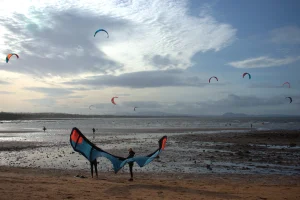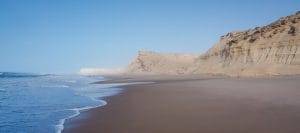

Masirah Island in Oman isn’t a destination you’d choose for classic sights, well-kept beaches, or a rich tourist infrastructure. Its value lies elsewhere. Masirah is a raw, windy, empty and at times unforgiving island, where nature still sets the rules. Precisely because of this, it has become one of the most important places in the world for sea turtle nesting.
Turtle nesting is a natural process. Observing this process is a privilege that above all requires patience from the individual.
Why is Masirah so special?
Masirah lies on the coast of the Indian Ocean and has tens of kilometers of long, almost uninhabited sandy beaches. These very beaches are the key reason sea turtles keep returning here again and again. Without heavy urbanization, without mass lighting, and without intensive tourism, the turtles still have the conditions they are rapidly losing elsewhere.
Several species of sea turtles nest on the island, including:
• green sea turtle,
• loggerhead turtle,
• olive ridley turtle,
• occasionally also hawksbill turtle.
Masirah is particularly important for the loggerhead population, as it is one of the largest known nesting areas for this species.
When does nesting and hatching take place?
Sea turtle nesting on Masirah takes place mainly during the warmer part of the year.
• Egg laying: May–September
• Peak nesting: June–August
• Hatchling emergence: July–October
The process takes place almost exclusively at night. The reason for this is simple: lower temperatures, fewer predators, and fewer disturbances.
How does nesting take place?
When an adult turtle climbs from the ocean onto the beach at night, it looks for a suitable patch of sand above the tide line. Using its flippers, it digs a nest and lays its eggs in it. In one nesting, a turtle typically lays around 80–120 eggs, most commonly about 100. Once the nest is covered, the turtle returns to the sea. With that, its task is complete. It does not guard the nest, does not return to the hatchlings, and does not monitor the outcome.
Why are turtles observed at night?
Turtle watching is permitted exclusively at night, and even then only under strict conditions. The key reason is minimizing stress for the animal. Sea turtles are extremely sensitive to light, especially white and blue light, which they associate with danger or a daytime environment.
That’s why red light is used, which:
• disturbs the turtles’ orientation less,
• reduces the likelihood the turtle will abandon nesting,
• allows for basic visibility without a direct impact.
The use of flashes, strong lights, or phone flashlights is strictly prohibited.
Hatching – the most dangerous moment in a turtle’s life
After about 45–60 days, the hatchlings emerge from the eggs. Hatching often happens at night or in the early morning hours. The hatchlings instinctively orient themselves toward the brightest part of the horizon – under natural conditions, this is the reflection of the moon and stars on the sea surface.
Artificial light can completely disrupt this orientation.
Of around 100 hatchlings, only a few will reach adulthood.
Reasons: • predators (birds, fish, crabs), • disorientation due to light, • physical exhaustion, • natural selection.
Average estimates show that 1–5% of hatchlings survive to adulthood, often even less.
Is watching the nesting a tourist experience?
No. And this is precisely where Masirah fundamentally differs from better-known locations such as Ras Al Jinz.
On Masirah:
• there are no guaranteed tours,
• there is no infrastructure for mass visits,
• there are no schedules,
• there are no promises.
Visitor responsibility If you find yourself on Masirah during nesting season, you’re not there as a spectator, but as a guest in a place where one of the oldest natural cycles on the planet is taking place. The basic rules are clear: • no touching, • no flashes, • no approaching without permission, • no walking on potential nesting sites. A single wrong step can mean the loss of an entire nest.
Conclusion Masirah and sea turtle nesting aren’t a story about an “experience,” but the observation of a natural process. If you have luck, patience, and the right attitude, you can witness one of the most vulnerable, yet at the same time most most majestic, natural processes.
If you don’t see anything, it doesn’t mean nothing happened. It may simply mean you were respectful enough to give nature its space.
And this is perhaps the greatest value you can take away from Masirah. Besides the excellent spots, of course.